Mosque of Ibn Tulun
📍 Get there
Coordinates: 30.0289, 31.2494
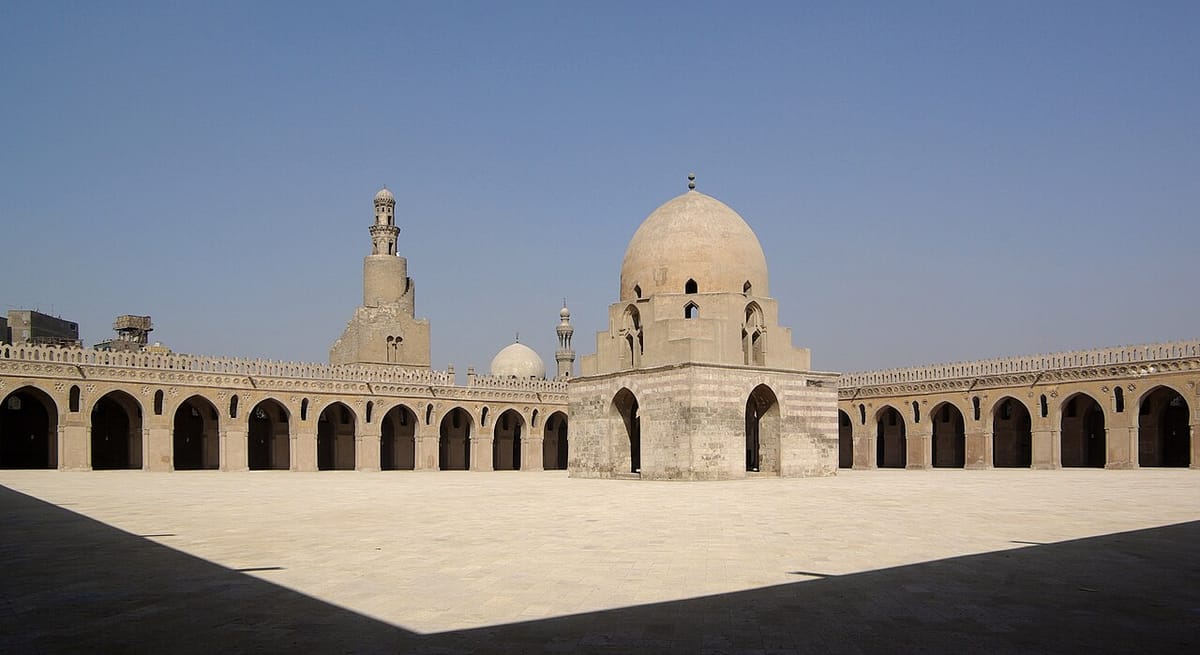
The Mosque of Ibn Tulun was built between 876 and 879 AD by Ahmad ibn Tulun, the governor who made Egypt a near-independent state. It is the oldest mosque in Cairo that survives largely in its original form, and one of the largest in area.
The style is unlike anything else in Cairo: plain brick arcades with pointed arches and delicate stucco borders around an enormous open courtyard. Its unusual minaret has an outside spiral staircase, inspired by the great mosque of Samarra in Iraq. The domed fountain in the middle was added in 1296 by the Mamluk sultan Lajin.
The mosque is quiet, rarely crowded, and one of the most peaceful places in the city. Film fans may recognise it from the 1977 James Bond film The Spy Who Loved Me.
Highlights
- The huge courtyard and repeating brick arcades
- Carved stucco decoration under the arches
- The spiral minaret - climb it for views over Islamic Cairo
- The Mamluk fountain dome in the courtyard
- The Gayer-Anderson Museum built against its wall
Visiting
- Opening hours: daily, roughly 8 am – 5 pm, outside prayer times
- Tickets: free; a small tip for the shoe keeper is customary
- Dress: covered shoulders and knees; women should bring a scarf
- Time needed: 45 minutes, more if you climb the minaret
- Nearby: Gayer-Anderson Museum, Sultan Hassan Mosque, Cairo Citadel