Abu Simbel
📍 Get there
Coordinates: 22.3372, 31.6258
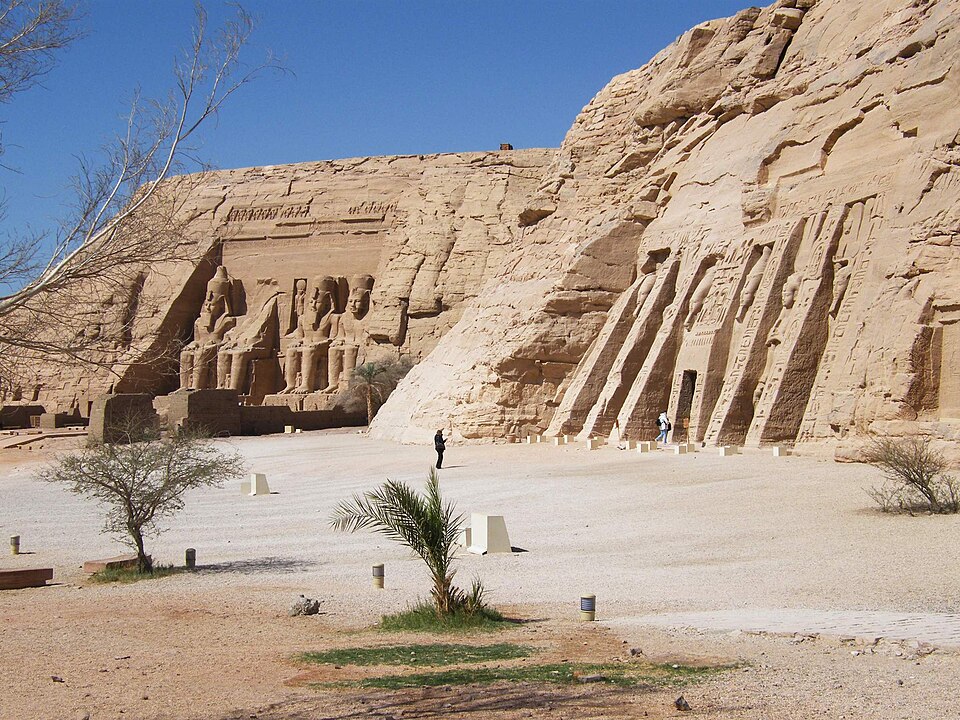
Abu Simbel is the southern frontier statement of Ramses II - two temples carved straight into a sandstone cliff above the Nile, designed to overawe Nubian travellers heading north and to project Egyptian power deep into Africa. The Great Temple is fronted by four seated colossi of the king, each 20 m tall, and inside, an axial corridor lined with osirid statues leads to a sanctuary cut 60 m into the rock. Twice each year - on or about 22 February and 22 October - sunlight reaches all the way to the sanctuary and illuminates three of the four gods seated there (Ptah, the god of darkness, is left in shadow).
The smaller Temple of Hathor and Nefertari beside it is one of only two temples in ancient Egypt dedicated to a queen, and the only one where her statues stand on the façade at the same height as her husband's - a remarkable architectural compliment.
Both temples were sawn into more than 1,000 numbered blocks in 1964–1968 and lifted 65 m up the cliff to escape the waters of Lake Nasser - UNESCO's most famous rescue project.
Highlights
- Four 20 m colossi of Ramses II on the Great Temple façade
- Inner sanctuary, aligned for the sun-festival twice a year
- Temple of Nefertari dedicated to Hathor
- View of Lake Nasser stretching south
- After-dark Sound-and-Light show
Visiting
- Opening hours: 5 am – 6 pm
- Tickets: ~600 EGP foreign adults
- Getting there: flight from Aswan (40 min) or road convoy (3.5 hrs each way); easier as an overnight at the small town of Abu Simbel
- Best time: the two sun-festival dates if you can plan around them
- Nearby: Philae, Temples of Wadi al-Sebua
Getting there
Abu Simbel is 280 km south of Aswan, about 3.5 hours each way by road. A private car for the day costs about $80–280 plus permits (2026), and most drivers leave before dawn so you reach the temples early.
See the private car day trip